
45 AI logo prompts that actually work (2026 update)
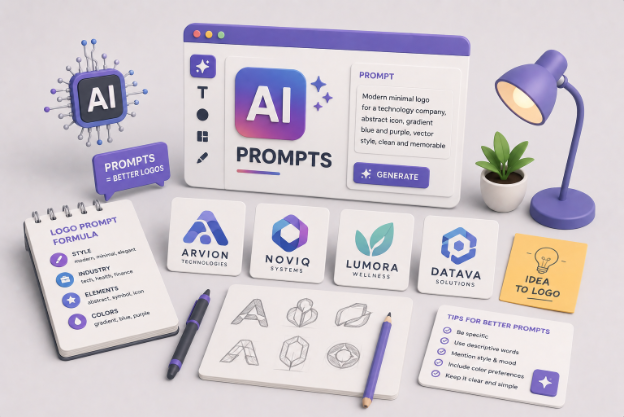
TABLE OF CONTENTS
An AI logo prompt is a text instruction that tells an image model what mark to generate. The ones that work name five things: subject, style, colour, mood and technical constraint. Below are 50 free copy-paste prompts, organised by logo type and industry, plus five written specifically for ChatGPT, the formula for writing your own, and the tools that handle each job.
TL;DR
- ✅ Every prompt that works names five things: subject, style, colour, mood, technical constraint. Miss one and you get generic output.
- 🎨 50 free prompts below: 37 by logo type, 8 by industry, and 5 built for ChatGPT's conversational editing.
- ⚠️ Generate the symbol and the wordmark separately. Image models still garble letterforms, so ask for "no text" and set the type yourself, or spell the name out letter by letter.
- 📊 Pick the tool by the file you need: Recraft V4.1 for true SVG, Ideogram 4.0 for legible type, Midjourney V8.2 for exploration, ChatGPT for refining through conversation.
- 👉 Test the result at 16 pixels and in one colour before you fall for it. AI gets you a direction in ten minutes. It does not get you a brand system.
Prompts written for the November 2026 model lineup. AI image tools change monthly, so the wording holds up longer than the tool names do.
What is an AI logo prompt?
An AI logo prompt is the text instruction you give an image model to generate a logo concept. Unlike a general image prompt, it has to carry design constraints as well as subject matter: flat vector rather than photographic, white background, minimal detail, readable at small sizes. Those constraints are what separate a usable concept from a pretty picture.
The single most useful thing to understand is that you are prompting for a concept, not a finished asset. No current model reliably produces a production-ready logo file. What a good prompt gets you is a direction worth showing someone, in about ten minutes rather than a week.
The five-part logo prompt formula
Every prompt on this page follows the same five-part structure. Learn it once and you can write your own for any brand.
- Subject. The core object, symbol or letters. Be concrete: "a folded paper fox head", not "something animal-related".
- Style. The visual approach. Minimalist, geometric, vintage, line art, 3D, flat vector.
- Colour palette. Two or three colours, named or as hex codes. More than three and the model loses control of the composition.
- Vibe or mood. The feeling: professional, playful, luxurious, energetic, trustworthy.
- Technical constraints. The format rules: flat vector, white background, no text, minimal detail, app-icon ready.
Part five is the one most people skip, and it is the one doing the heavy lifting. Without it you get illustration. With it you get something shaped like a logo.
The formula in action: weak prompt vs strong prompt
Here is the same brief, a neighbourhood coffee shop, written two ways. Coffee is one of the most crowded logo categories there is: browse our collection of coffee shop logos and count the beans, cups and steam curls. That is exactly why the prompt has to work harder than "a coffee shop logo".
What changed in AI logo generation in 2026
Three things shifted this year, and they change which tool you should reach for.
Vector output stopped being a fantasy. For years every AI logo guide ended with the same caveat: you will get a PNG and you will need a designer to redraw it. Recraft now generates editable vector graphics directly, which is the first genuine answer to that problem rather than a workaround. It does not make the output good, but it does make the output editable.
Type inside images got legible. Garbled letterforms were the defining failure of AI logo generation. Ideogram 4.0 is built around exactly this, promising readable type in every layout. Wordmarks are now worth attempting rather than automatically farming out to a separate step, though the separate step is still the safer default.
The model names all changed. Midjourney's default is V8.2 as of 24 July 2026. OpenAI's current image model is GPT-Image-2. Google's is Nano Banana 2, formally Gemini 3.1 Flash Image, which launched on 26 February 2026 and is now the default across the Gemini apps. If a guide still says "DALL-E 3" or "Midjourney v6", it has not been touched in two years.
What has not changed: none of these produce a brand. They produce a mark, and a mark is maybe fifteen percent of an identity. More on that in our wider look at AI in graphic design.
The best AI logo prompts by logo type
Grouped by the seven standard types of logos. Swap the brand names and colours for your own and the structure holds.
Wordmark logos
A wordmark is the brand name as the logo. These are the hardest for image models, so generate several and expect to reset the type properly afterwards.
- A futuristic wordmark logo for a tech brand named NEXUS. Heavy-weight custom sans-serif, the letter X stylized as two arrows meeting. Electric blue and charcoal grey. Flat vector, white background, high readability.
- An elegant luxury wordmark for a fashion label named AURA. High-contrast serif typeface, wide letter spacing to suggest exclusivity. Pure black text on white, sharp edges, minimalist.
- A friendly wordmark for a bakery named POPPY. Rounded hand-lettered script, warm and inviting, terracotta and cream palette, flat vector on white, balanced spacing.
- A confident wordmark for a fintech brand named LEDGER. Geometric grotesque sans-serif, the letter G closed into a perfect circle. Deep green and off-white, flat vector, white background, stable and precise vibe.
- A playful wordmark for a children's brand named WOBBLE. Soft rounded letterforms with uneven baselines, as if hand-drawn. Sunshine yellow and deep teal, flat vector, white background, no outline.
- A stark editorial wordmark for a magazine named FOLIO. Condensed high-contrast serif in all caps, tight tracking, one letterform partially cropped by the edge of the frame. Black on white only, flat vector.
Lettermark and monogram logos
Initials only. These are the most forgiving prompts because the model has less to get wrong.
- A sophisticated monogram combining the letters S and D, interwoven using golden-ratio geometry. Flat design, no shading, royal blue and gold. Vector style, clean lines, white background.
- A bold lettermark for the letter P. Negative space inside the loop forms a lightning bolt. Modern geometric style, solid bright red on white, app-icon ready.
- A minimal lettermark for the letters A and R sharing a single diagonal stroke. Constructed from three line weights only, monoline style. Black on white, flat vector, geometric and rational vibe.
- An architectural monogram of the letters K and V built as if from folded ribbon, with implied depth from flat colour alone and no gradients. Slate grey and burnt orange, flat vector, white background.
- A circular lettermark for the letter O, formed from two crescents that do not quite meet. Precise geometry, single weight, deep indigo on white, calm and modern, app-icon ready at 32 pixels.
Pictorial and brandmark logos
A recognisable object, simplified. The best prompts here name one object and one transformation.
- A minimalist pictorial mark of a leaf transforming into a water drop. Simple geometric shapes, flat vector, forest-green-to-teal gradient. No text, white background, symmetrical, app-icon ready.
- A pictorial logo of a folded paper fox head. Origami style, sharp clean facets, orange and slate grey. Flat vector, white background, minimal detail so it scales down cleanly.
- A simple pictorial mark of a mountain peak reflected into a lake, forming an abstract letter M. Two-tone deep blue, flat vector, white background, balanced and calm vibe.
- A pictorial mark of a key whose teeth form a tiny city skyline. Single-weight line art, no fill, navy on white, flat vector, no text, trustworthy and precise vibe.
- A pictorial mark of an open book whose pages become a flock of birds at the top edge. Flat vector, two colours only, warm ochre and deep brown, white background, minimal detail.
- A pictorial mark of a coffee cup seen directly from above, where the crema swirl forms a fingerprint. Flat vector, single warm brown on cream, no text, app-icon ready, distinctive and human vibe.
Abstract logos
No recognisable object. Prompt for what the shape should communicate rather than what it should depict.
- An abstract logo representing connectivity and speed. Fluid organic shapes swirling together, warm-orange-to-magenta gradient, clean vector edges, white background, energetic vibe.
- A geometric abstract mark of three overlapping hexagons with transparency where they intersect. Navy, slate, and silver. Precision-engineering vibe, flat design, white background.
- An abstract mark suggesting growth, built from four rectangles of increasing height rotated slightly around a shared centre point. Single teal on white, flat vector, optimistic and structured vibe.
- An abstract mark representing balance, two interlocking curved forms of unequal size that together make a stable whole. Charcoal and coral, flat vector, white background, no gradient, calm and confident.
- An abstract mark built from a single continuous line that crosses itself exactly three times to enclose two shapes. Monoline, uniform weight, deep purple on white, flat vector, app-icon ready.
Emblem logos
Type inside a contained shape. Detailed by nature, so the scaling constraint matters more here than anywhere else. The category is worth studying before you prompt: our collection of coffee shop logos is mostly emblems and shows how much detail actually survives at cup size.
- A circular emblem for a coffee roaster. Center illustration of a stylized coffee bean, curved text path reading EST 2019. Vintage textured style, warm browns and cream. Vector, detailed but scalable.
- A modern shield emblem for a cybersecurity brand. Inside the shield, a lock built from circuit lines. Metallic silver and cyber green, sleek and authoritative, flat vector, white background.
- A hexagonal emblem for a craft brewery. Inside, a stylised barley stalk crossed with a hop cone. Two-colour letterpress feel, deep red and bone white, flat vector, bold enough to read on a bottle cap.
- A rounded-square emblem for a neighbourhood bookshop. Inside, a simplified shopfront awning above three book spines. Muted sage and warm grey, flat vector, white background, friendly and local vibe.
- A circular emblem for an outdoor guiding company. A single pine silhouette centred, sun rays as seven straight lines behind it, curved text path reading SINCE 1998. Forest green and cream, flat vector, minimal detail.
Mascot logos
A character. Prompt for pose and attitude, not just species, or you get a generic clip-art animal.
- A fierce e-sports mascot logo of an aggressive snake head with glowing eyes. Thick bold outlines, comic-book vector style, toxic green and black, high-energy dynamic pose.
- A cute 3D Pixar-style mascot of a smiling toaster, glossy soft lighting, pastel palette, friendly and inviting, isolated on white, suitable for a bakery brand.
- A bold falcon mascot for a delivery brand, mid-flight carrying a small parcel. A few speed lines to suggest motion, red and yellow, flat vector, confident and fast vibe.
- A calm owl mascot for a tutoring service, shown in three-quarter view wearing simple round glasses, no other props. Flat vector, four colours maximum, warm navy and mustard, patient and clever vibe.
- A stubborn goat mascot for a hiking gear brand, head lowered and front hooves planted, seen in strict side profile. Thick uniform outlines, two-tone charcoal and rust, flat vector, white background.
Combination logos
Icon plus wordmark. Specify the arrangement, or the model will invent one.
- A horizontal combination logo for a real estate brand named HAVEN. Left: a minimalist geometric house-roof icon. Right: HAVEN in a clean modern sans-serif at the same height. Navy blue and terracotta, flat vector.
- A vertical combination logo. Top: line-art mountain peak. Bottom: SUMMIT GEAR in a rugged slab-serif. Black ink on white, adventurous, clean and scalable.
- A horizontal combination logo for a dental practice named NORTHFIELD. Left: an abstract tooth formed from two overlapping rounded shapes. Right: the name in a light geometric sans-serif, all caps, wide tracking. Soft blue and white, flat vector.
- A stacked combination logo for a plant nursery named ROOTSTOCK. Top: a simplified root system drawn as five downward lines meeting a horizontal ground line. Bottom: the name in a friendly rounded sans-serif. Deep green on cream, flat vector.
- A horizontal combination logo for a recording studio named THIRD FLOOR. Left: three stacked bars of decreasing width suggesting both a waveform and a staircase. Right: the name in a condensed uppercase sans-serif. Black and electric yellow, flat vector, white background.
Free AI logo prompts you can copy right now
Every prompt on this page is free to copy and use. This set is organised by industry rather than logo type, for when you know your sector but not your format.
- A sleek modern logo for a tech startup named LUMINA. Minimalist geometric spark symbol, cool blue palette, innovative and clean vibe, flat vector, white background.
- A cozy wordmark for a cafe named EMBER. Rounded warm serif, small steam curl over the E, brown and cream, artisanal vibe, flat vector on white.
- A professional lettermark for a law firm, initials H and C interlocked, subtle scales-of-justice negative space. Navy and gold, serif, trustworthy and established, flat vector.
- A bold abstract mark suggesting forward motion and strength, angular arrow shapes, black and electric orange, high-energy vibe, flat vector, white background.
- A friendly combination logo, rolling-pin-and-wheat icon beside the name FLOUR & CO in a soft rounded serif, warm pastel palette, welcoming vibe, flat vector.
- A minimalist pictorial mark of an abstract cloud made from three overlapping rounded rectangles, blue-to-purple gradient, modern and reliable vibe, flat vector, app-icon ready.
- A pictorial mark of three organic leaf shapes overlapping with transparency, earthy greens and warm beige, natural and renewable vibe, no text, flat vector, white background.
- A minimalist lotus formed from negative space, soft pink and warm grey, calm high-end vibe, flat vector, white background, symmetrical.
Building a mark for yourself rather than a company? The same prompts work, but the brief is different. We covered that in how to design a personal logo. For more on prompt construction generally, our Midjourney prompts guide goes deeper on syntax and parameters.
ChatGPT logo prompts: 5 built for conversation
ChatGPT works differently from the other tools on this page, because you are not limited to one prompt. You can brief it, react, and edit in plain language across several turns. The prompts above all work in ChatGPT as written. These five are designed for how ChatGPT actually behaves: they use the conversation instead of fighting it.
The workflow that works best is two steps. First, let ChatGPT interview you and write the prompt. Then generate, and refine one thing at a time. Changing one variable per turn is the habit that separates a usable logo from twenty near-misses, because when you change three things at once you cannot tell which change helped.
- Act as a senior brand identity designer. Before generating anything, ask me five short questions about my business, audience and competitors. Then write three distinct logo prompts, each using a different logo type, and explain in one sentence why each direction fits. Do not generate images yet.
- Generate three distinct logo directions for a bookkeeping firm named TALLY on one canvas, labelled A, B and C. A: a lettermark. B: an abstract mark suggesting order. C: a combination mark. Navy and mint only, flat vector, white background, no mockups, no shadows, no gradients.
- Create a wordmark that reads exactly "Field & Flour", spelled F-I-E-L-D, ampersand, F-L-O-U-R. Warm rounded serif, wheat brown on cream, artisanal and friendly vibe, flat vector, white background. Do not add any other words, letters or taglines.
- Keep the symbol exactly as it is: same shape, same proportions, same position. Change only the colour palette to charcoal and coral. Do not redraw, simplify or add anything.
- Show this logo on one canvas in five versions side by side: at 16, 32 and 64 pixels wide, in solid black on white, and in solid white on black. Label each version. Flat, no mockups.
Prompt 46 is the one to start with if you do not have a brief yet. Prompt 50 is the one to run before you commit to anything, for reasons covered in the testing section below.
Which AI tool should you use for logo prompts?
The tools are no longer interchangeable. Pick by what you need out the other end.
A few notes behind that table. Recraft was the first mainstream tool to generate real vector paths rather than a raster image in an SVG wrapper. Ideogram 4.0 was built around readable type, which was the defining failure of AI wordmarks. OpenAI's Images 2.6, released on 4 November 2026, added SVG output for developers using the API, so Recraft is no longer the only route to a true vector file. Google's Nano Banana 2 is the default image model across the Gemini app. And Adobe trains Firefly only on content it has rights to, which is why legal teams tend to prefer it.
If you only take one thing from this section: the vector question decides your tool before the aesthetics question does. A beautiful PNG that has to be redrawn by hand costs more than a mediocre SVG you can fix. We compare the template-based options separately in our roundup of logo makers, Canva logo design covers the no-prompting route, and our wider look at AI in graphic design covers where these tools fit beyond logos.
Fixing common AI logo prompt problems
Four failures account for almost everything that goes wrong. Each one has a prompt-level fix.
Problem: garbled or invented letters
Weak prompt: "A logo for a bakery called POPPY with the name underneath."
What you get: POPYP, POPPYY, or a fourth P appearing from nowhere. Most image models still treat letterforms as shapes rather than characters.
Corrected prompt: "A pictorial mark of a poppy flower, flat vector, terracotta and cream, white background, no text." Then set the wordmark yourself, run the type through Ideogram separately, or use the spell-it-out approach in prompt 48.
Problem: it says vector but it is a PNG
Weak prompt: "A vector logo of a mountain peak, SVG format."
What you get: A raster image that looks vector-ish, with soft edges that will not recolour cleanly or scale to a billboard. Typing "SVG" into a raster tool does not change what it outputs.
Corrected approach: Generate in Recraft's vector models, or through the OpenAI API with SVG output switched on. In every other tool, prompt "flat vector style, hard edges, no gradients, no texture, solid fills only" and accept that you are getting a concept to redraw.
Problem: it looks like every other logo
Weak prompt: "A modern minimalist logo for a wellness brand, calming colours."
What you get: A leaf. Possibly a leaf inside a circle. Vague prompts return the statistical average of the category, which is by definition the most generic thing in it.
Corrected prompt: "A pictorial mark of a single eucalyptus seed pod, drawn as three overlapping teardrops, flat vector, sage green and bone white, white background, no text." One ownable detail beats five adjectives.
Problem: too detailed to survive a favicon
Weak prompt: "An intricate emblem with a detailed lion, banner ribbon, and ornate border."
What you get: Something handsome at full size and an illegible smudge at 16 pixels, which is the size it appears in a browser tab.
Corrected prompt: Add "minimal detail, maximum three elements, readable at 16 pixels, no thin lines under 2 pixels at final size."
How to test an AI logo before you use it
AI output always looks best in the image it was generated in: large, centred, often on a soft mockup the model added without asking. Strip that away before you decide anything. Five checks take ten minutes and catch most of the problems that otherwise turn up after launch.
- Remove the mockup. Judge the mark flat, on plain white. If it only works on a glossy business card render, it does not work.
- Shrink it. View it at 16 and 32 pixels. If the idea disappears, simplify the prompt and regenerate. Prompt 50 does this for you in ChatGPT.
- Drop the colour. Solid black on white and solid white on black. A logo that depends on a gradient will fail on a fax, an embroidery file or a one-colour print job.
- Read every letter. Check the spelling character by character, at full size. AI errors in type are easy to miss when the overall shape looks right.
- Check the file. Open it in a vector editor. If you cannot select individual paths, it is a raster image, whatever the file extension says.
That last check matters because the file format decides what you can actually do with the logo:
or the mistakes that only show up once a logo is in use, our guide to logo design mistakes picks up where this checklist stops.
Can you use, copyright or trademark an AI-generated logo?
These are three different questions, and most guides blur them. This is general information, not legal advice. Rules vary by country, and anything you plan to register is worth a lawyer's review.
- Commercial use depends on the tool's terms. Most paid plans grant you commercial rights to what you generate. Free tiers vary, so read the terms of the specific tool before the logo goes on anything you sell.
- Copyright is the hard one in the US. The US Copyright Office's January 2025 report concluded that prompts alone do not give enough human control to make you the author of the output. What can be protected is the human contribution: meaningful modifications, or your own creative selection and arrangement. A mark generated from a prompt and used as-is is unlikely to be protected.
- Trademark works differently. It protects a mark you use to identify your business, and the bigger risk with AI is similarity. Models learn from existing logos, so an AI mark can land uncomfortably close to one that is already registered. Run a trademark search before you commit.
The practical takeaway: an AI concept that a designer then redraws and develops is in a much stronger position than raw output. Our logo design cost guide covers what that professional route costs.
Frequently asked questions
Final word: you do not have to settle for an AI logo
AI prompting is genuinely good at one thing: getting you from a blank page to a direction in an afternoon, cheaply, with enough variations to know what you do not want. That is real value and it did not exist five years ago.
What it does not do is decide anything. It will not tell you why a competitor owns green, or how the mark behaves on a delivery van versus a favicon, or what happens to the logo when you launch a second product line. Those are the decisions that make an identity work, and a prompt cannot make them because a prompt does not know your business. We argued this at length in why an AI logo generator cannot compare to a human designer, and looked at the wider question in will AI replace graphic designers.
Use the prompts to explore. When you find a direction worth keeping, that is the point to bring in someone who can build a system around it. ManyPixels covers logo design alongside everything else on one subscription, from $699 a month on the Advanced plan: up to 2 hours of design a day, unlimited revisions, and full ownership of the source files, including true vector. If you only need design for a stretch, you can pause for $10 a month. Explore ManyPixels plans to see what that covers.
{{LOGOS_PORTFOLIO="/dev/components"}}
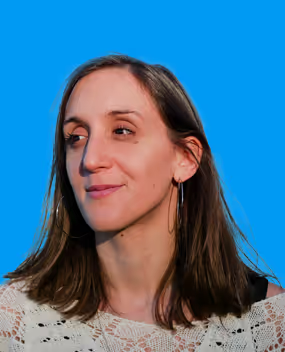
Having lived and studied in London and Berlin, I'm back in native Serbia, working remotely and writing short stories and plays in my free time. With previous experience in the nonprofit sector, I'm currently writing about the universal language of good graphic design. I make mix CDs and my playlists are almost exclusively 1960s.

Top-quality designers
A complete creative team at your fingertips: graphic designers, illustrators, motion designers and more.
Lightning-fast turnaround
Get started today and receive your first update on the next business day.
All-inclusive pricing
Unlimited requests and revisions. One flat monthly fee. No surprises.
Flexible & scalable model
No contract. Scale up and down as needed. Pause or cancel anytime.
Continue reading
Explore some of our best designs
Get inspired by a curated selection of ManyPixels work. Download the portfolio to see what our team can create.